Jay Moore is a well-known historian 'round these parts, and we even had him kick off the State of the City with a brief history lesson. He then sent this in an email to an undisclosed list of folks, and my coworker forwarded on to me. I love me some Abilene history, so I'll share it here if you are interested too :)
I actually always wondered why Abilene didn't have the traditional small-town-Texas "courthouse square" and now I know why!
----
Happy Birthday to The Future Great!
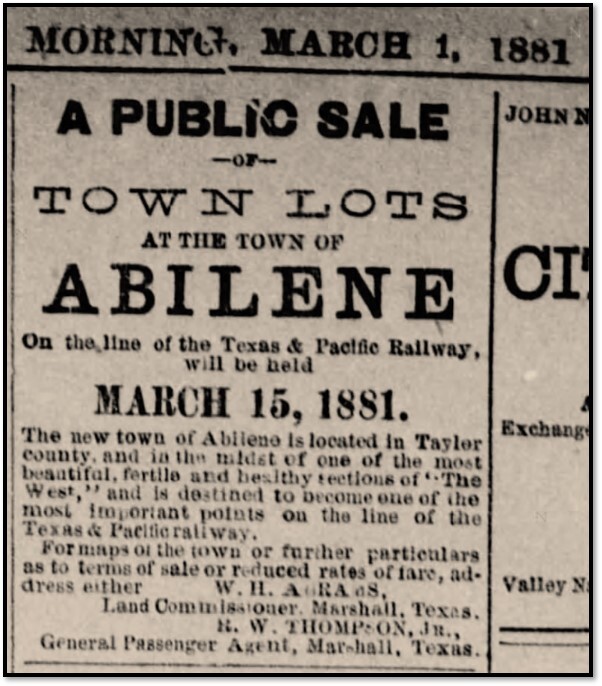
On Sunday, March 15, our ol’ prairie town will turn 145 years old. Many cities and towns slowly evolve into being, but we can claim an exact day, even an exact hour, to mark our beginning: the day we were auctioned into existence at 10 A.M. on a Tuesday.
Despite the fact that several hundred people were already milling about in northern Taylor County in the weeks prior to March 15, 1881, we consider that day as our delivery date since it was on that chilly morning that the Texas & Pacific Railway staged an auction to sell lots in the new town they marketed as “The Future Great City of West Texas.” And when auctioneer J. A. Hossack hammered the first lots sold, Abilene was born.
So that he could be seen and heard by a crowd estimated from one to two thousand, Mr. Hossack climbed up onto some stacked railroad ties set up at Chestnut and S. 1st, behind him was a plat of the new town. He opened the bidding and John Berry of Belle Plain snatched up the first lot. He actually bought two adjoining lots at the northwest corner of N. 2nd and Pine. Those two 25-foot-wide lots have remained linked ever since. Today, they are the setting for Grain Theory.
Prior to the lot sale, folks were camped out in tents or sleeping under their wagons while they waited on the auction date. There was a tent hotel set up, and at least one pop-up saloon was in operation. Twelve days before the auction, a baby was born here to A.M. and Fanny Barnett; the proud parents named their infant daughter, Abilene. A church was even organized ahead of the auction when William Minter gathered together a passel of Presbyterians for a worship service on February 27 at N. 1st and Pine. We already had a graveyard too; necessary because a man named John Snoddy was killed here a month before the auction. (A jealous husband was a person of interest in the case.)
A Kentuckian named Josiah Stoddard Johnston was tasked with laying out the town and marketing the auction. He saw to it that surveyors measured lots and staked out the streets, and he decided there would not be a town square, rather two parallel streets fronting either side of the railroad tracks. He did plan for a courthouse square despite the fact that Buffalo Gap was the county seat. (Don’t bring that up while eating at Perini’s.)
Streets north or south of North and South 1st were numbered while the intersecting streets were given names of trees, with several being trees you won’t find in these parts, such as Cherry, Butternut, Beech and Hickory. (I’m perplexed as to why he left out Hackberry. We got plenty of those allergen producers.) A couple of the tree streets, namely Sassafras and Apple, never came to be and, in time, Magnolia was renamed N. Treadaway. Also, Orange is not the Florida variety, rather, the Osage Orange, which, I believe, is the same tree as a Bois D’Arc. (And, if you can’t place Bois D’Arc, it is two blocks east of N. Treadaway.) Johnston also decided that he would offset the north and south tree streets by a half block, so they don’t line up, and each arboreal road stops at N. 1st or S. 1st.
Well before sunrise on March 15th, a T&P engine pulling five passenger cars arrived here from Fort Worth. They were filled with speculators who rode out for our birth and to possibly invest in some Abilene real estate. But many of the buyers present that day were the Buffalo Gap crowd who understood that the new town of Abilene was, in fact, destined to be The Future Great City of West Texas.
So, let your hair down and treat yourself to a birthday cupcake on Sunday. We’re only 145 once.
- Jay